




Jones Jeep - 2026 Jeep Grand Cherokee vs 2026 Honda Pilot — Which SUV has the stronger towing and real 4x4 capability around Owings Mills, MD?
What do shoppers really mean by towing and 4x4 strength?
When drivers ask which three-row-capable SUV feels stronger for towing and true four-wheel traction, they often blend two questions: which one pulls with more confidence and which one keeps traction in marginal conditions without drama. Those are related but distinct. Towing is about powertrain output, cooling, transmission logic, and chassis stability. Real 4x4 capability is about traction hardware, low- and high-traction behavior, ground clearance, suspension travel, and the drive modes that tailor each system to the surface under tire. Around Owings Mills, MD—where daily drives mix I-795 lanes, rolling back roads, and occasional gravel or grass lots—both needs matter.
That’s why this guide zeroes in on the heart of the comparison: how the Jeep® Grand Cherokee and Honda Pilot approach towing and traction, and how those differences feel at the wheel when the load is heavy or the surface is uneven. Below, we break down the systems, then answer the layer of follow-up questions shoppers always ask before they choose.
Power and towing: What numbers and systems move the needle?
The Grand Cherokee brings a new 2.0L Hurricane 4 Turbo engine with up to 324 horsepower and 332 lb-ft of torque, paired to a next-generation Gen IV transmission. That pairing delivers a Best-in-Class maximum towing capacity of up to 6,200 pounds when properly equipped—headroom you feel the first time you crest a grade with a full family and a weekend’s worth of gear in tow. The transmission’s shift logic is tuned to hold gears predictably under load and settle quickly back into a quiet cruise, a small but meaningful detail on long runs up I-83 or west toward trailheads.
Honda’s 285-horsepower V-6 in the Pilot is familiar and smooth, and the 10-speed automatic is well-matched. Properly equipped, the Pilot is rated to tow up to 5,000 pounds. That’s plenty for lighter boats and compact campers, and many families will be satisfied. The key difference isn’t only the extra 1,200 pounds the Jeep® can handle—it’s the sense of reserve and control when crosswinds pick up or you encounter rolling hills. That reserve matters when you’re pulling a dual-axle trailer or packing the cargo area full for a multi-day trip.
Traction and control: What’s the real advantage of multiple 4x4 systems?
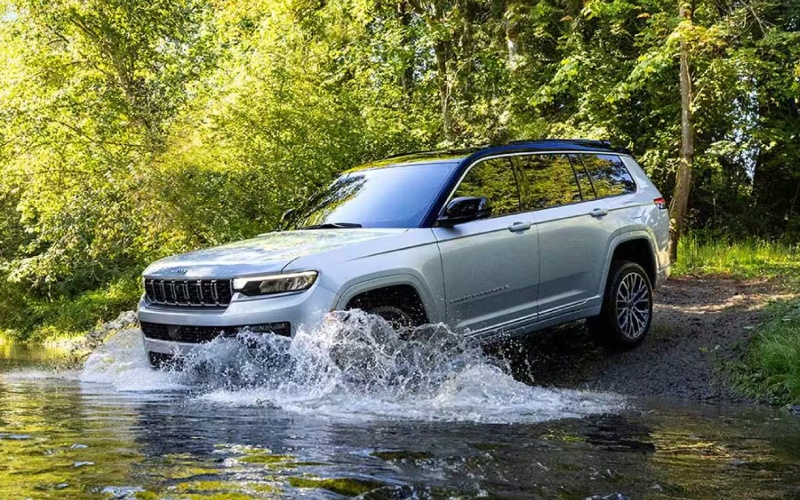
Jeep® offers three available 4x4 systems on Grand Cherokee—Quadra-Trac I®, Quadra-Trac II®, and Quadra-Drive® II with a rear electronic limited-slip differential. The spread lets you choose the level of off-pavement grip and towing composure you expect. Add the available Quadra-Lift® Air Suspension and Selec-Terrain® with Auto, Sport, Rock, Snow, and Mud/Sand modes, and the chassis adapts to the day’s surface quickly. In practice, that means you can ease down a slick boat ramp, transition to gravel, then merge onto dry interstate and the SUV’s posture and traction remain consistently calm.
The Pilot’s i-VTM4® AWD enhances stability, helps carve corners neatly, and adds reassuring snow-day traction. TrailSport raises the stakes with an off-road tuned suspension, skid plates, and all-terrain tires. For moderate trails and family getaways, it’s a welcome capability bump. Where the Grand Cherokee separates is in the combination of air suspension range, the available rear eLSD’s torque management, and the breadth of selectable modes—including Rock—designed with low-traction, uneven situations in mind.
How much does advanced driver assistance factor into towing comfort?
More than you might think. The Grand Cherokee’s available Hands-Free Active Driving Assist helps reduce fatigue on longer highway slogs by allowing hands-off driving on supported roads while it monitors for driver attention. Add the available 360º Surround View Camera for low-speed maneuvering with a trailer, and the optional Night Vision Camera to widen your awareness at dawn or dusk, and you get a safety net that’s particularly helpful when you’re towing and your mirrors are already busy. The Pilot’s Honda Sensing® suite is comprehensive and confidence-inspiring—with Adaptive Cruise Control with Low-Speed Follow, Lane Keeping Assist System, and more—but it does not add hands-free capability, and its camera set lacks an infrared option.
So which SUV feels better when towing to the lake or heading off the beaten path?
If your routine includes frequent towing or a desire to keep going when the surface gets unpredictable, the Grand Cherokee’s extra towing capacity, available air suspension, and three-tier 4x4 strategy provide a deeper toolkit. The Pilot’s ride quality and cabin ergonomics are excellent for everyday use, and TrailSport is a meaningful off-pavement step, but the Jeep®’s hardware breadth gives you a level of calm, adjustable control that stands out with a trailer connected or when the trail gets choppy.
How should a family in greater Baltimore approach a test drive?
Bring your checklist and simulate your day. Load up several passengers, combine city routes with a highway stint, and include a stretch of less-than-perfect pavement or a gravel access road if possible. If you plan to tow, ask about a route with some elevation changes. Pay attention to how the transmission holds gears under load, how stable the SUV feels in crosswinds, and how quickly its systems settle after a hard acceleration or braking event. Try the drive modes you’d realistically use. If you often navigate tight parking lots with a hitch installed, evaluate camera quality and how easily you can place the vehicle around curbs or obstacles.
Frequently Asked Questions:
Does the Grand Cherokee’s Best-in-Class 6,200-pound towing rating apply to every trim?
No. Towing limits vary by configuration. Your advisor can help you specify the right combination of engine, axle ratio, 4x4 system, and equipment to match your needs.
Is air suspension worth it if I mostly commute?
Yes if you value a smoother, more settled ride on uneven roads and want automatic aero-lowering at speed. It also pays off when loading passengers, aligning with a trailer, or gaining extra clearance on rough access roads.
Can the Pilot’s i-VTM4® AWD match the Jeep® in mud and rocks?
For moderate trails and snow, the Pilot is capable and reassuring. In low-traction, uneven terrain where articulation and torque vectoring over larger axle yaw are needed, the Grand Cherokee’s available Quadra-Drive® II with rear eLSD and Rock mode provide an advantage.
Which has the more advanced long-haul driver assist?
The Grand Cherokee offers available Hands-Free Active Driving Assist on supported highways, which the Pilot does not. Both offer strong adaptive cruise and lane support features to ease daily driving.
Ultimately, your best comparison is a back-to-back drive. If you need stronger towing and a wider envelope of traction tools for Maryland seasons and weekend plans, the Grand Cherokee is engineered to check those boxes while still feeling composed and premium day to day. If your towing is light and you prioritize a familiar V-6 feel and a roomy, well-organized cabin, the Pilot remains a solid alternative. One visit to Jones Chrysler Dodge Jeep Ram—serving Parkville, Owings Mills, and Glen Burnie—will help you pinpoint which strengths matter most for your family’s routes. We invite you to explore the hardware, ask questions, and see how the systems behave on roads that mirror your life.
Ready to take the next step? Our product specialists can outline how each configuration aligns with your towing plans, terrain, and tech preferences, then set up a route that reveals the differences where you’ll feel them most.
To get started or schedule time for a focused side-by-side drive, simply reach out to our team at Jones Chrysler Dodge Jeep Ram and tell us about your routine, your trailers, and your weekend goals. We’ll do the rest.
Request more 2026 Jeep Grand Cherokee information
Categories:
Jeep Grand Cherokee